How emerging technologies redistribute power—and what institutions must do to make their systems contestable, accountable, and repairable.
THE PROBLEM
Technology does not enter neutral institutions. It inherits their defaults—and can make them harder to see, question, and repair.
Across clinics, classrooms, workplaces, financial systems, and public agencies, emerging technologies are being embedded in consequential decisions before institutions have established whose evidence counts, who can refuse, or what happens when a system causes harm.
The result is not simply technical error or biased output. These systems redistribute authority, risk, care, and accountability—often leaving the people most affected with the least power to challenge the decision or secure repair.
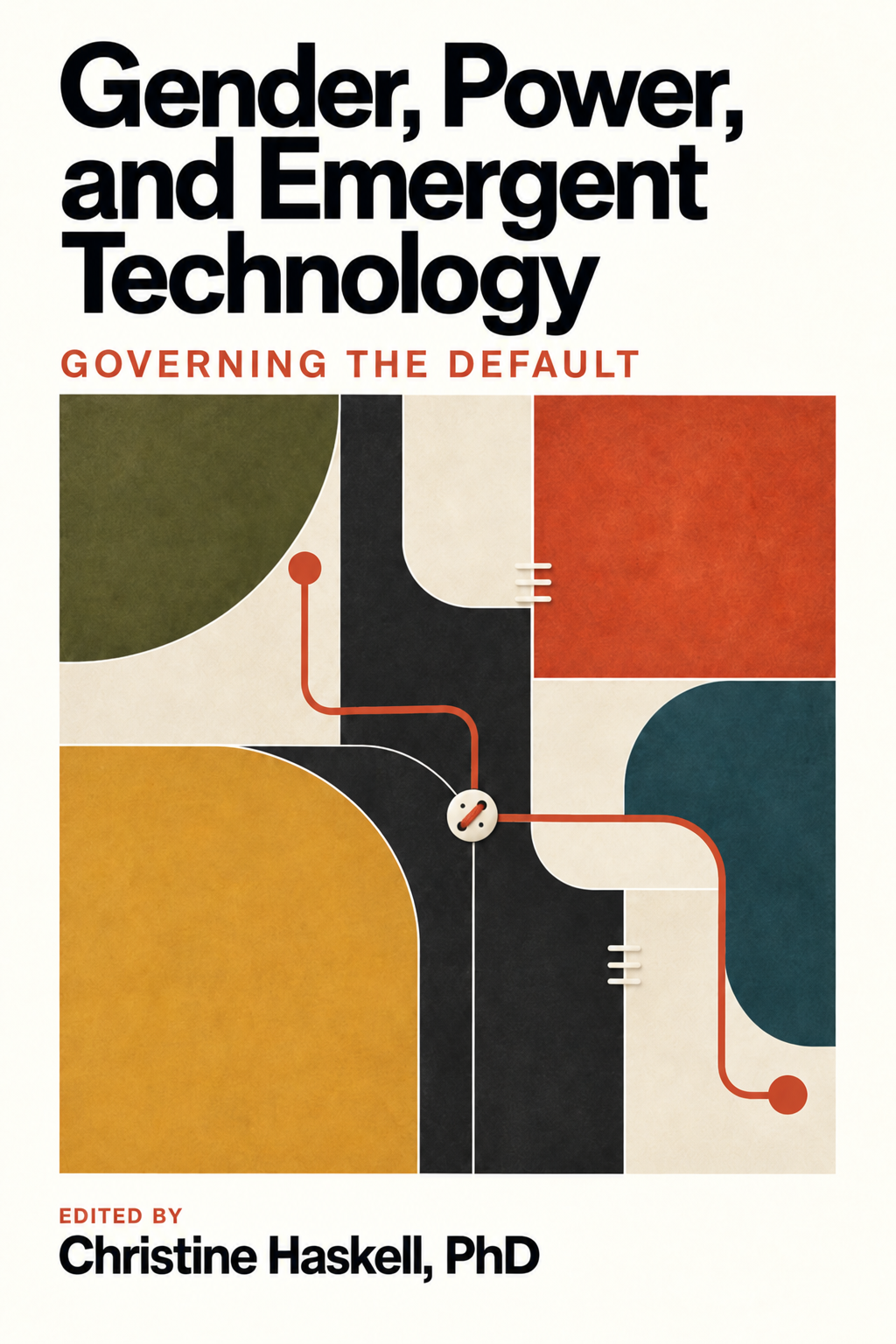
Book Cover Placeholder
WHAT THIS VOLUME DOES
This volume examines how these defaults are produced, whose knowledge and labor they obscure, and how institutions can make technological systems more contestable, accountable, and repairable.
Across eight chapters, contributors move beyond identifying bias to ask harder governance questions:
>Who has standing to object?
>Who bears the burden when systems fail?
>Who has the authority to pause their use?
>And what makes repair enforceable rather than optional?
Gender, Power and Emergent Technology
Governing the Default
EDITED BY
Christine Haskell, PhD
Scholar, consultant, and teacher at the intersection of data, systems, and behavior. Three decades of experience in technology and governance inform this volume’s call for relational accountability in AI-mediated institutions.
RIGOROUS SCHOLARSHIP
Interdisciplinary research grounded in real-world consequences.

DIVERSE VOICES
Women scholars and practitioners across sectors and geographies.

PRACTICAL INSIGHTS
Frameworks and tools for governance in practice.

TEACHING RESOURCES
Custom-ready materials for instructors and learners.
WHAT THE BOOK OFFERS

EPLORE THE CHAPTERS
VIEW ALL CHAPTERS AND CONTRIBUTORS
PRAISE FOR THE VOLUME
“The most interesting interventions do not simply critique existing systems; they change our ability to perceive them. Gender, Power, and Emergent Technology does exactly that, showing how questions of care, consent, refusal, and repair belong at the heart of governance rather than at its periphery. In doing so, it bridges knowing and acting, making this an intellectually generous and practically ambitious collection.”
—MINNA SALAMI,
author of Can Feminism Be African? and Sensuous Knowledge
“This book is a very important and timely contribution to the AI governance debate, adding an essential feminist and relational lens. It moves beyond theoretical discussion to offer practical tools that can be adopted now in this rapidly developing field.”
—CAROLINE GREEN,
Director of Engagement, Institute of AI Ethics, University of Oxford
“This book shows that technology governance is also an evaluative question: whose knowledge counts, whose context matters, and who has authority to name harm, success, and repair. By centering African, Indigenous, feminist, and justice-centered ways of knowing, the volume offers practical pathways for more accountable governance.”
—PROFESSOR BAGELE CHILISA,
Postgraduate Research and Evaluation Programme, University of Botswana; Author of Indigenous Research Methodologies
“Too often, AI tools are handed to clinicians with great attention to accuracy and almost none to how decisions actually get made at the bedside. This volume treats that gap as the central governance problem. It is timely and genuinely usable.”
—MAX TOPAZ, PhD, RN, MA, FAAN, FIAHSI,
Associate Professor, Columbia University & VNS Health
FIELDS OF PRACTICE
Higher Education
Healthcare & Public Health
Nonprofits & Philanthropy
Government & Policy
Technology & Data Governance
Workplace & Human Resources
RESOURCE KIT
Instructor Guide, Discussion Questions, Case Studies, and Slides to Support Teaching and Training
[coming soon!]
COMMON QUESTIONS
Who is this book for?
Is this a technical book on AI?
Does the book include teaching materials?
How can I invite authors to speak?