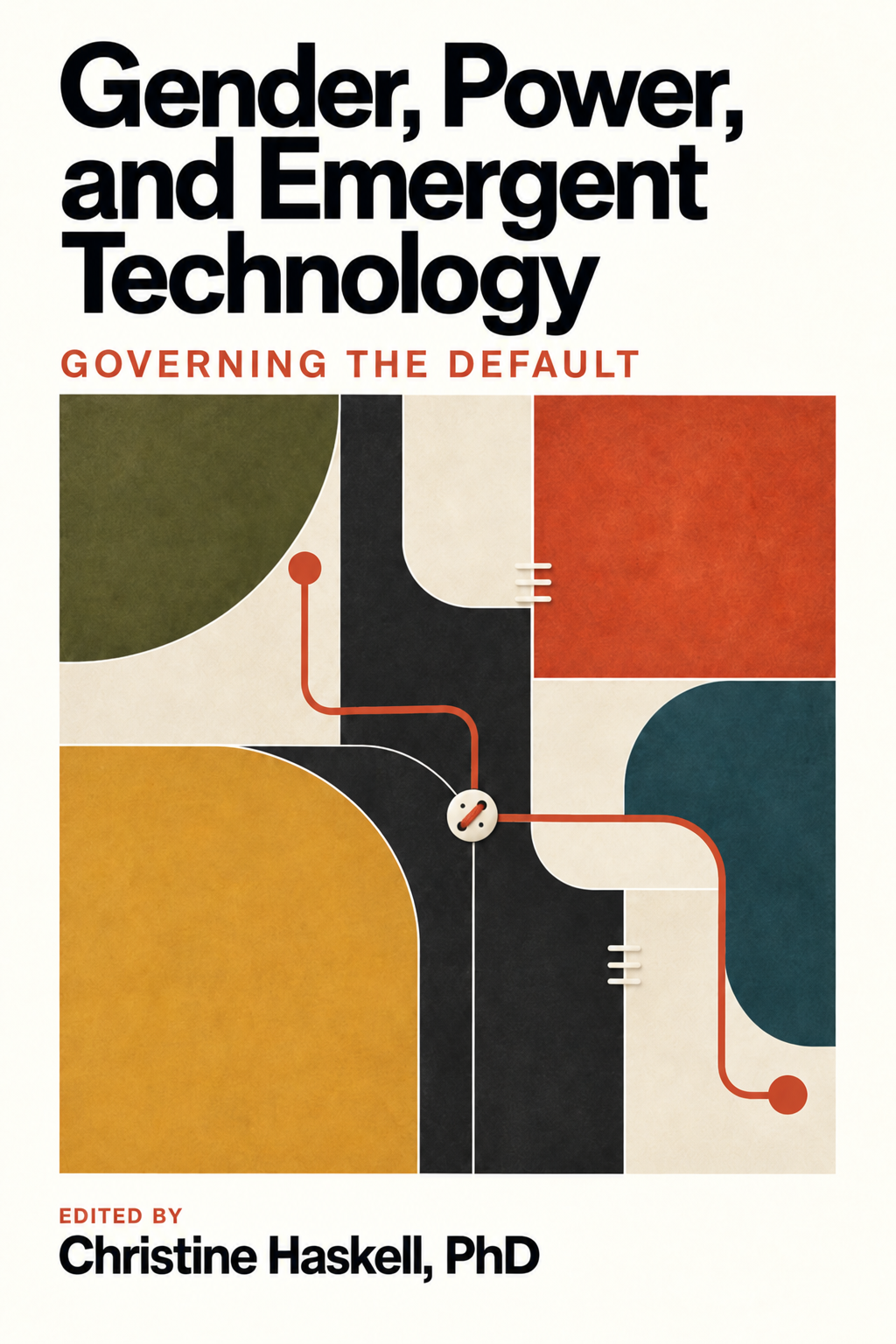
The Volume Guide
Meet the authors
[Book Cover Image: Coming Soon!]
Eight chapters trace how emerging technologies redistribute power, widen inequity, and challenge accountability. They offer practical tools for making those systems more visible, contestable, and repairable.
NEW TO THE VOLUME?
Start the introduction for the book’s central argument and four governing questions.
Those marginalized, trivialized, and ignored have clearer vision: not only do they name the dynamics and issues, they experience them. Here women use direct experience and scholarship to sharpen a lens not available elsewhere.
--MARGARET WHEATLEY,
author of many books, including Leadership and the New Science, Who Do We Choose to Be?, and Restoring Sanity
“
EXPLORE THE CHAPTERS
Each chapter approaches the volume’s governing questions from a different setting and knowledge tradition. Read in sequence or begin with the issue most relevant to your work.

AFRICAN KNOWLEDGE SYSTEMS / RELATIONAL ETHICS
Ethics as Fermentation: Ubunt/ Ma’at
Wakanyi Macharia-Hoffman & Dr. Annette Markham
Relational accountability traditions as living ethics for technology governance.

CULTURAL WISDOM AND PRACTICE
AI DOESN’T MENTOR LIKE WE DO
Dr. Emaneli “Emi” Barresi
Mentorship is not informal support work; it is relational infrastructure for attention, trust, accountability, cultural translation, and the development of judgment.

ABSENCE, DISTORTION, AND POLITICS OF AI KNOWLEDGE
Herstory as Analytic Lens
Kira Sjöberg
AI systems not only erase marginalized knowledge; they distort it, down-rank it, and make it appear less credible.

WOMEN’S HEALTH, FEMINIST FUTURES, AI GOVERNANCE
Beyond Bias
Dr. Johnna D. Wesley, Heather Stegner, Dr. Heather H. Ward
The question is not whether a health AI system is accurate, but whether it can be paused, questioned, redesigned, refused, and repaired before harm is scaled.

YOUTH, MENTAL HEALTH, TECHNOLOGY & AI SAFETY
Governing the Heart of the Machine
Christine Haskell, PhD, & Leah Jacobs
When young people absorb AI’s emotional costs, relational harm becomes a governance issue—not a private family problem.



FINTECH, NIGERIA, FINANCIAL SYSTEMS
Making Participation Legible
Prof. Nubi Achebo, Ph.D
Financial systems exclude women when they define valid evidence too narrowly. This chapter makes economic participation visible, contestable, and institutionally revisable.
RELATIONAL DRIFT, SYNTHETIC INTIMACY, K-12 EDUCATION
Is Friendship Technology?
Tricia Friedman
As AI companions reshape friendship and care, institutions must define relational boundaries before platforms define them by default.
HYPERLOCAL, PUBLIC TRUST
The Hyperlocal AI Governance Cycle
Sarah J. Bland
Local governments need more than vendor promises or high-level policy; staff, residents, and oversight bodies need ways to shape AI where it enters public work.
USING THE VOLUME
-
No. The chapters are designed to work both as part of the full volume and as stand-alone entries into particular governance questions. Readers can move through the book in sequence or begin with the chapter most relevant to their field, institution, or concern.
-
Yes. Each chapter introduces its own problem, argument, and practical contribution clearly enough to be assigned or discussed on its own. The volume becomes especially powerful, however, when readers begin to see how the chapters speak to one another across settings.
-
Instructors new to the volume may want to start with the Introduction, then select one or two chapters that align most closely with their course goals. The Teaching Guide and Resource Kit are designed to help faculty identify suitable chapters, frame discussion, and adapt the material for different disciplines and learning contexts.
-
Each chapter page highlights its featured resource and explains how to use it. The Resources page brings these materials together and helps readers locate teaching tools, discussion guides, and practical applications connected to the volume.
-
That depends on the question you are working through. Some chapters are especially useful for education, youth wellbeing, and counseling; others speak more directly to health care, leadership, finance, public policy, or local government. If you are unsure where to begin, the Resources page includes a Start With Your Problem guide to help route you to the most relevant chapters.
For a complete list of FAQ questions click here.
TAKE THE VOLUME INTO PRACTICE
Teaching materials, discussion guides, and practical tools support classroom, organizational, and facilitated learning.